

Actions
An action in System Initiative is a kind of function which performs a specific operation on a resource, such as creating, updating, or deleting it. Actions are the bridge between your intended configuration (components) and their associated resources. When you apply a change set, the actions enqueued within it are executed to align reality with what you have modeled.
Actions only run after their dependencies succeed, ensuring that resources are updated in the correct order based on their relationships.
Types of Actions
System Initiative supports several types of actions, each serving a specific purpose in the lifecycle of infrastructure resources:
Create Actions
Create actions provision new resources in your cloud provider based on their component's configuration. They are automatically enqueued to the change set when you add a new component that should have an associated resource.
When you apply a change set containing a create action, it executes, sending the component's configuration to the cloud provider. If the action is successful, it returns a resourceId that identifies the newly created resource. Then, a refresh action automatically runs afterward to populate the resource data for the component.
Refresh Actions
Refresh actions query your cloud provider to retrieve the current state of a resource and update the resource data for its component. They ensure the component's configuration accurately reflects reality.
Refresh actions are triggered automatically after successful create pr update actions. They can also be run manually.
Update Actions
Update actions apply configuration changes to existing resources. They are automatically enqueued when you modify the properties of a component that already has an associated resource.
Delete Actions
Delete actions are automatically enqueued when you delete a component that has an associated resource. They remove the actual resource from your cloud provider.
When you delete multiple related components, delete actions execute in reverse dependency order - for example, a subnet will be deleted before its VPC.
Manual Actions
Manual actions are custom functions defined for specific components that don't fit into the standard create/update/delete lifecycle. For example, a manual action might restart a service, update a cluster configuration, or perform a one-time maintenance task.
Manual actions must be explicitly enqueued to be run.
Action Lifecycle
Actions follow a specific lifecycle within System Initiative:
- Enqueuing: Actions are automatically added to the change set when you create, modify, or delete components
- Pending: The action is queued and waiting to be executed
- Execution: When you apply the change set, actions run in dependency order
- Completion: Actions either succeed or fail
- Persistence: Failed actions remain enqueued until they succeed or are manually removed
TIP
System Initiative records your intent to take an action, and it remains present on HEAD until it succeeds or is intentionally removed. This means you can retry failed actions without having to recreate them.
Action Execution Order
Actions are executed in an order determined automatically by the relationships between components. For example:
- A VPC must be created before its subnets
- Subnets must be created before instances that use them
- Resources are deleted in reverse dependency order
You don't need to specify action ordering - System Initiative determines the correct sequence based on subscriptions between components.
Actions and Change Control
Actions are only executed from HEAD - the change set representing "the real world." This ensures that all infrastructure changes flow through the change control process.
When you work in a change set:
- Actions are enqueued based on your changes
- You can review all proposed actions before applying
- No changes are made to the actual infrastructure until you apply the change set
- After applying, actions execute and modify real resources
Refresh actions and qualifications are the only functions that can run directly on HEAD without going through a change set, since they don't modify resources - they only read current state or validate configuration. These are the core properties set
Action Arguments
Action functions take an Input argument. It has a properties field, which contains an object that has:
The
sipropertiesThese are the metadata properties specific to System Initiative.
The
domainpropertiesThese are the core properties specified in the schema itself, usually 1:1 with the resource properties.
The
resourcedataThis is the output of the last action, stored as the state of the resource. It contains 3 fields:
- status: a string representing the current status of the resource ("ok", "warning", "error", etc.)
- message: an optional message
- payload: the resource payload itself
The
resource_valuedataThis is information pulled into the component properties from resource payload data. These are properties added with the
addResourceProp()method of a component's schema.Any generated
codeGenerated code is available as a map, whose key is the name of the code generation function that generated it.
Action Return Value
Actions return a data structure identical to the resource data above. You should be careful to always return a payload, even on error - frequently, this is the last stored payload if it existed.
if (input?.properties?.resource?.payload) {
  return {
    status: "error",
    message: "Resource already exists",
    payload: input.properties.resource.payload,
  };
}
Remember that message is optional:
return {
  payload: JSON.parse(child.stdout).DBCluster,
  status: "ok",
};
Payload should be returned as a JavaScript object.
Listing Actions
To list actions with the AI Agent:
List actions for the "example" change setAI Agent's Response:
⏺ I'll list the actions in the example change set for you.
⏺ The "example" change set has 2 actions:
| Action | Component | Schema | Kind | State |
|---------|-----------|----------------------|---------|--------|
| Destroy | example-1 | AWS::EC2::KeyPair | Destroy | Queued |
| Create | example-2 | DigitalOcean Project | Create | Queued |
Both actions are queued and will run when the change set is applied. The first will destroy an AWS EC2 KeyPair, and the second will create a DigitalOcean Project.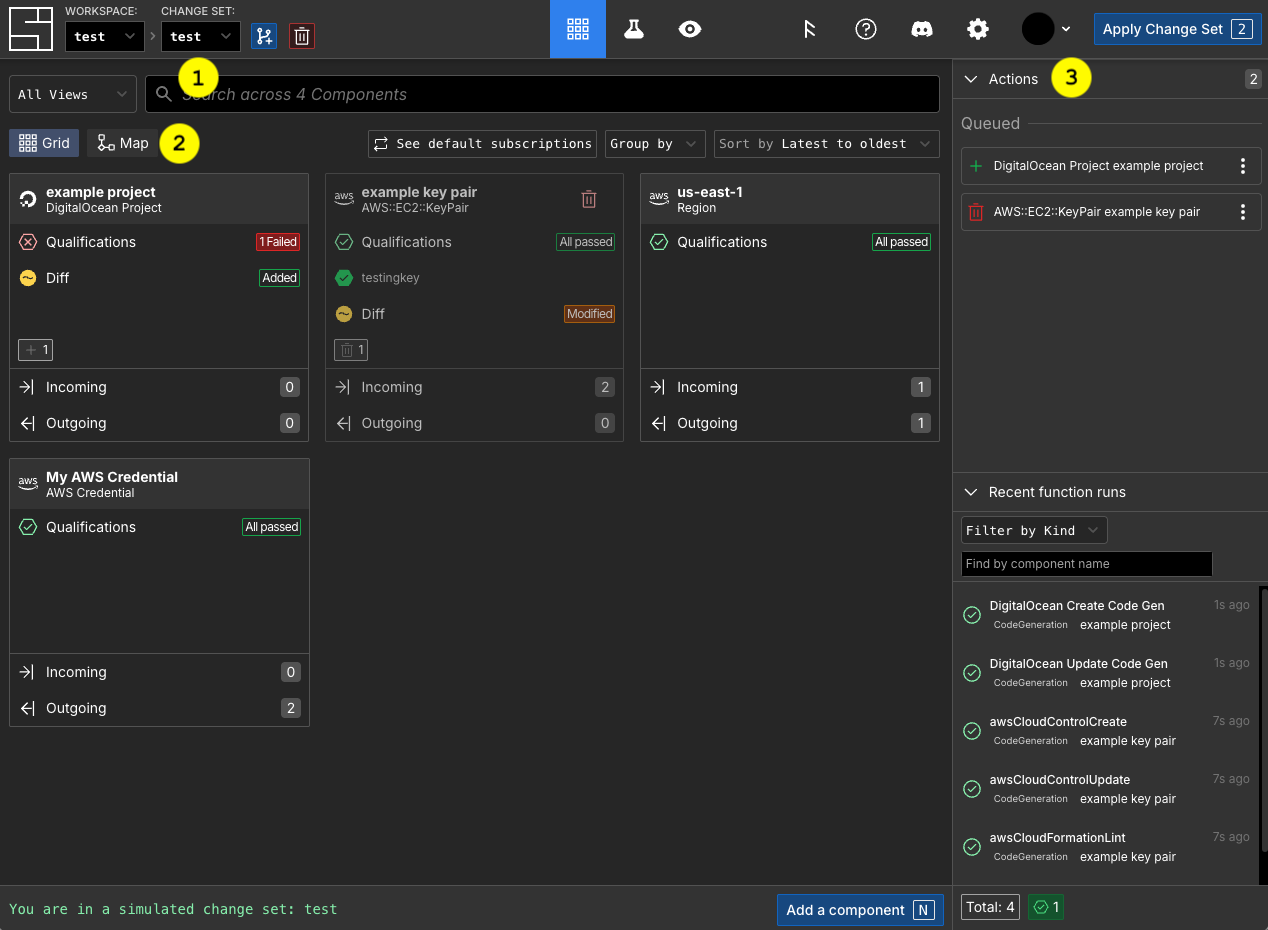
Removing a Queued Action
To remove an action with the AI Agent:
Remove the create action for the DigitalOcean Project in the "example" change setAI Agent's Response:
⏺ I'll help you remove the create action for the DigitalOcean Project in the "example" change set.
⏺ Let me first list the available change sets to find the correct ID for the "example" change set:
⏺ Now let me list the actions in the "example" change set:
⏺ Perfect! I found the Create action for the DigitalOcean Project. Now I'll remove it:
⏺ Done! I've successfully removed the Create action for the DigitalOcean Project (component "example-project") from the "test" change set. The action has been removed from the queue and will no longer execute when the change set is applied.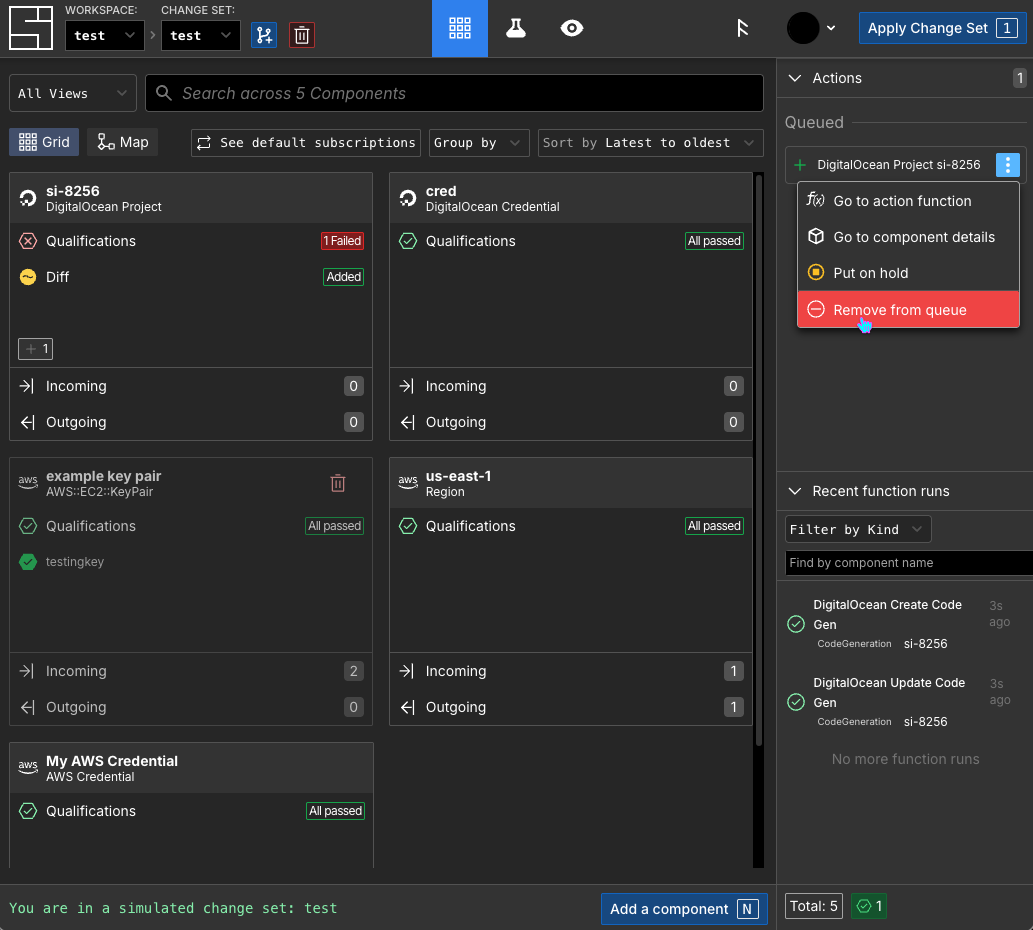
Putting an Action On Hold
To remove an action with the AI Agent:
Put the create action for the DigitalOcean Project in the change set "example" on hold.AI Agent's Response:
⏺ I'll put the create action for the DigitalOcean Project on hold in the "example" change set.
⏺ First, let me find the change set and list the actions to identify the DigitalOcean Project create action.
⏺ Now let me list the actions in the "example" change set:
⏺ Perfect! I found the create action for the DigitalOcean Project. Now I'll put it on hold:
⏺ Done! I've successfully put the Create action for the DigitalOcean Project component "example-project" on hold in the "example" change set. The action will not execute, and any dependent actions will also be blocked until you take it off hold.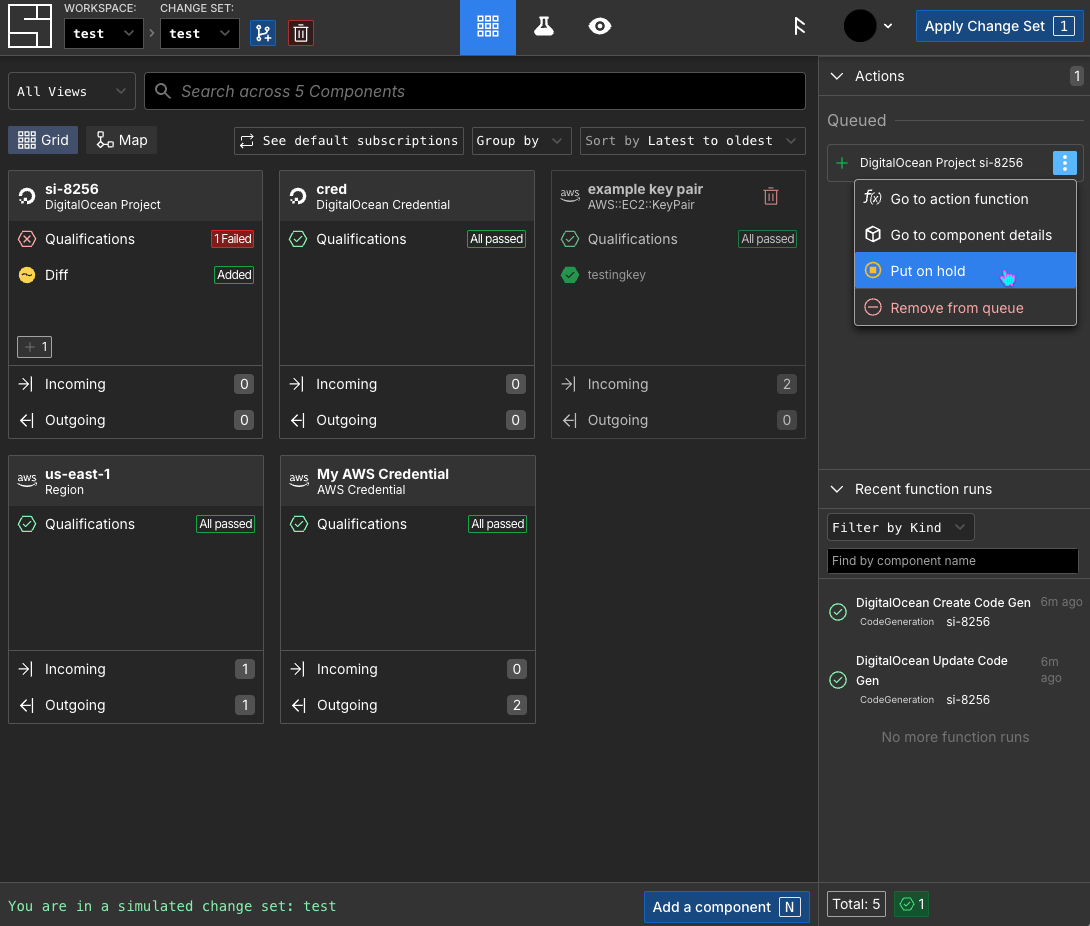
Retrying Actions
To retry actions with the AI Agent:
Retry the DigitalOcean Project create actionAI Agent's Response:
⏺ I'll retry the Create action for the DigitalOcean Project.
⏺ Successfully retried the Create action for the "example project" DigitalOcean Project.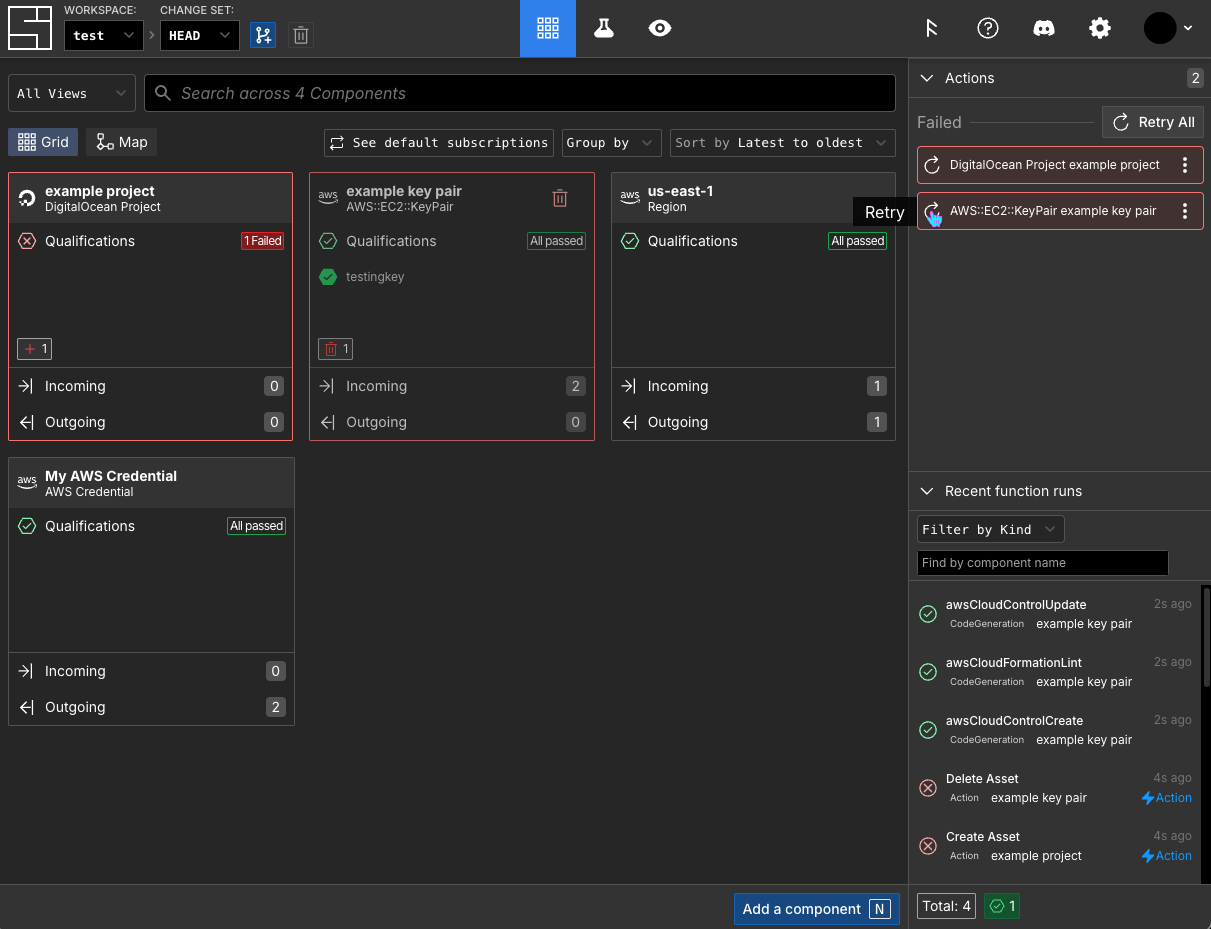
See Also
For detailed examples and technical implementation details, see the Action Function Examples section in the Functions Reference.